Monday, April 5, 2010

Vibrator - 2003 -Ryuichi Hiroki

I first watched this movie almost a year ago, and I have to say that it left a pretty big mark on me. I had probably picked it up off the shelf of the video store two dozen times over the course of a year before I finally took it home. I typically choose a director and then plow through their entire catalog before moving on. So, when I noticed that Ryuichi Hiroki had a few to select from, specifically Tokyo Trash Baby (Tokyo Gomi Onna) and I am an S & M Writer (Futei no kisetsu), I have to admit that I found myself somewhat intimidated by the overt sexual connotations that were smack dab in the titles of his films. Not that I would be embarrassed to rent or watch pornographic films. No. It was just that I wasn't quite sure what I was jumping into with this director. Japanese portrayals of sexuality in film have quite a range, and I have found that the more prevalent depictions border on the fetishistic and/or the immature. When given the titles I am an S & M Writer, and Vibrator I assumed that I was in for films that were over sexed and lacking in plot/character development. I was completely (and gratefully) wrong. I could immediately empathize with Rei and Takotoshi -with their longing for something real and true in a world that offers them little beyond the work that they have cut out for themselves- with how desperation leads them to attach themselves to falsities, and to find and attach themselves to each other.

Before I get into the plot, I should mention that I
watched this film last night in Japanese, without subtitles. I have only been studying Japanese for a little over a year, so my memory of the actual conversations, and my translations, may fail me.
We are first introduced to Rei as she stands alone in a convenient store looking through the alcohol selection, her inner monologue guides her over to the magazines and back again. We are immediately aware of insecurities from her ongoing conversation with herself: her dependence on alcohol and and unhealthy relationship with her body. It is obvious that Rei is lost in the convenient store, lost as to what to buy, lost as to why she is there, and lost in herself. When a man with blond hair walks in she immediately notices him, her phone starts to vibrate in her coat pocket, over of her heart. He catches her watching him and we see him pass her in the aisle and brush his hand over her butt. Her phone vibrates again. This could be accidental or creepy- some guy in a convenient store catches you spying on him and grabs your ass -yes, the situation is a bit awkward. But after hearing Rei's monologue, I understood why she would follow this guy into the parking lot, climb into his truck, and have some Shochu with him. She is looking for something to invigorate her, perhaps even redefine her.
Ryuichi Hiroki began his career in 'pinky' films (Japanese sex-ploitation movies of the 1970's), which explains how he competently captures sexual encounters that border on pornography, without the excessive nudity or sex. The first encounter between Rei and Takotoshi occurs in the back of a truck and Hiroki manages to capture sexual intimacy in close quarters without invading or disturbing. The removal of each piece of clothing and the bits of foreplay -all which could easily make us forget that these people are complete strangers- provide revealing intimate details that reveal each characters yearning to latch onto another. The element of mystery is still visible in how they fumble around and react with surprise to each change in position (I mean, Rei tells Takotoshi her name while he is between her thighs). A powerful desire to give in and let go is the nature of the encounter.

It is the next morning when we see that Rei is bulimic, she throws up her shochu and corn chips, swishes her mouth out with water, and asks Takotoshi to join him on his journey. We find them in the truck together traveling though the countryside. Both are freelance workers -Rei is a writer and Takotoshi is an independent truck driver- the nature of this work probably testifies to a deeper fear of failure and commitment. During the ride, Takotoshi tells Rei that he is married and has a daughter, and explains that she isn't the first girl that he has had an affair with. He paints a callous picture of himself for Rei, telling her stories of mistreating women and drug deals. He immediately sets his relationship with Rei up for failure to protect himself from getting in too deep and potentially having to continue it after the road trip. Despite the fact that Rei does not reveal too much about herself to Takotoshi, she hides herself from him by pretending to be cool when she is anything but. As the ride goes on and Rei begins to feel vulnerable, we see her problems -both physical and emotional- surface. She is surprised that Takotoshi doesn't judge her while she breaks down in front of him; he stays by her, and her inner monologue expresses surprise at how he is able to know just how to care for her without being told.
Hiroki does an excellent job of taking Rei and putting her in the foreground, while keeping her problems below the surface; her psychological problems, bulimia, and taste for alcohol are a part of a deeper problem that is not entirely revealed. Women with dependency problems on film often annoy me, as I usually find they are one-dimensional caricatures of the real thing. Rei offered a good balance despite the fact that she is slowly breaking down throughout the film. Takotoshi provides the support that she needs throughout the ordeal and in the end brings her back to emotional and physical reality -here she confronts the validity of his stories, is able to tell him that she likes him, and is returned to the convenient store where they found each other. She picks up her basket and returns to life as she knew it. Now, I unfortunately don't think that they meet again after this. But, rather, I think that this journey taught Rei and Takotoshi that they need other people, complications and all.
 

Thursday, April 1, 2010

Tokyo Zombie 2005 Sakichi Sato


I have to admit, I am not a big fan of horror films. This might stem from the fact that I wasn't really allowed to watch them while growing up and usually found myself disappointed when I would sneak peaks at them at friends houses. Despite the fact that I have enjoyed quite a few zombie films, I think my horror disillusionment must have leaked into the zombie genre, because even though I have liked a few, I could really care less about most of them. Insert Tadanobu Asano and I pick it up off the shelf without even reading the synopsis, or blinking, for that matter. So, when the film started, as pretty as he is, I thought it was on a downhill slope. The cheap sexual jokes were a bit crude and I couldn't really get past some of the cheese. And then something changed; it got funny.

東京ゾンビ is based on the manga by Yusaku Hanakuma, and it isn't your typical gory zombie movie. In fact, the zombie's are kind of background for Fujio- an afro-ed Tadanobu Asano, and Mitsuo- a bald Sho Aikawa, slackers who live in a fire extinguisher factory where Mitsuo mentors Fujio in jujitsu. In one of the first scenes we find them on the floor of the fire extinguisher factory, locked together in a jujitsu embrace. They take turns humorously switching up their positions until Mitsuo's boss comes in to yell at him. He pushes Mitsuo onto a carpet, rolls him up in it and starts slapping him on his bald head, degrading him. Fujio quietly picks up a fire extinguisher and smashes the man on the head with it, killing him. The pair react with surprise -not horror- and Fujio exclaims that he didn't mean to kill him. Oh well, they decide to bury him on Black Fuji -a mountain of toxic waste and trash where many an accidental death are laid to rest, though they actually turn into zombies. Fujio and Mitsuo are unaware that they are actually dealing with zombie's at first, and we watch them come to realize what is happening to them and then decide to head north, to Russia, and become real men. Except, they actually end up driving in circles and encountering more zombie's.

The pair are hilarious together; their relationship touches on love, companionship, teacher student, father son. I thought that the part where Mitsuo sings a poem about his health problems to Fujio was absolutely adorable- when he finishes, he explains that he wrote a poem because it would be too embarrassing to just talk about -it reveals just how close they are, even though this is already kind of obvious because they are often found locked together on the floor; they do bicker like an old married couple. As the story progresses Fujio and Mitsuo are separated; we watch Fujio 'become a man,' worship a Mitsuo shrine, and continue dreaming about going Russia where his jujitsu will truly be appreciated -all while fighting zombie's for a living. I thought this movie was funny, adorable, heartwarming, disturbing, and totally worth staring at Tadanobu Asano for. I anticipate a sequel might tie up what is left open at the end.


Tuesday, March 30, 2010

Stacy - 2001 - Naoyuki Tomomatsu

  A friend lent me this goretastic film about young girls who die and come back as zombie's called 'Stacy's.' The girls first succumb to this annoying disorder called NDH, Near Death Happiness, where they walk around on their tippy toes, giggle after everything that they say, talk excitedly about the death that they await, and talk endlessly and boringly about love. I think that we are supposed to find this NDH behavior adorable, as the men in the film are broken to tears watching these beautiful girls succumb to NDH knowing that they will be forced to repeat-kill them. If I watched someone experience NDH, I wouldn't wait until they died to kill them -I cannot describe how annoying it is to watch someone dance around ranting and raving about love, and how beautiful love is, and how special love is, and how love is what all of the Stacy's want while they tear people apart and eat their flesh.

On the subject of flesh eating, this is pretty gory. Of course the movie has its bloody young girls tearing people apart and the token mad scientist who dissects twitching pieces of Stacy flesh -all of which has a Troma-esq feel to it. A government agency called "Romero Repeat-Kill Troops" take care of the Stacy's by cutting them up into pieces and destroying them. Buckets full of twitching body parts prep you for the scene with the scientist (see left), whose experiments involve moving innards. Not that any of this is all that realistic, or original, or too hard to look at gross. It is just gory.

There is also this team of Drew Barrymore fan girls that have taken it upon themselves to repeat-kill the Stacy's because
they realize that the Stacy's only want to be repeat-killed by the person that they love most, and want the same for themselves when they die. I have a surprise, I also hated the Drew fan girls! They were just as annoying as the Stacy's. In fact, this whole movie was full of female caricatures that I think were supposed to be hot, or cute, or cool, and were simply annoying. I know that this is a zombie movie, and that I shouldn't expect much more from it, but it was pretty rough. I got through it and would probably have given it a better review if it wasn't for Eiko -the girl that the film centers on. We watch Eiko fall in love and go through NDH, die, come back as a Stacy and get killed by her lover. And then we find that her lover goes on to write the book of love and makes a statue for Eiko where she died. He tells us about the Stacy revolution where people learn how to love Stacy's and they actually stop eating flesh. I could not get past Eiko's terrible rant about love. Her lecture at the end of the film actually felt like a lecture, it was painful and unconvincing. My friends were all squirming and yelling about how they couldn't believe the movie wasn't over while she was rattling on about fluffy love love shit shit. It was killing me. I almost Stacy'd myself to escape it. So, even though I could appreciate the gore and the Troma quality to the movie, I absolutely was bored to hell with it. Oh, and annoyed.

Ran - Japan 1985- Akira Kurosawa

I just watched Ran on the big screen at the Coolidge Corner Theater. It was re-released to celebrate Kurosawa's centennial. I have to admit that I am a big fan of Japanese cinema, and love the films I have seen from Yasujiro Ozu and Kenji Mizoguchi, but had yet to sit through an entire Kurosawa film until today. I have attempted to watch them in the past, but few held my attention or distractions won me from the television set. So, Kurasowa's final epic was my first Kurosawa film, and it will definitely not be my last.
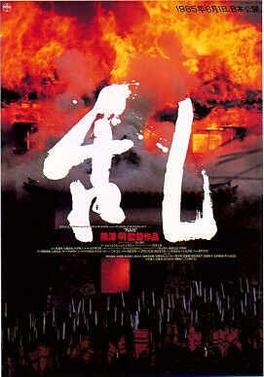
乱 - Ran, is translated as 'revolt; rebellion; war;' and the film is all about war and the chaos that it creates. We watch the Ichimonji clan fall after its leader Hidetora passes the torch to his sons who then betray him. It is revealed that Hidetora gained all of his wealth and power through treachery and the viewer watches the sons betray him, and then each other, for a taste of power - all only sip the broth before being taken out by the next in line. The film opens with a tired Hidetora falling asleep during a meeting with his sons and another clan. When he awakes he is frightened by a nightmare where he finds he is completely alone and afraid. At this point in the film, I thought Hidetora might be going a little mad -his sons exclaim that he is exhausted, and the rash behavior that follows this nightmare seems to occur as a result of it - he declares his retirement, which seems sudden, based on the reactions of his sons and advisers. He decides to give his leadership and his first castle to his first son Taro, his second castle to his second son Jiro, and his third castle to his third son Saburo. The first and second sons begin praising their father, thanking him for his faith in them and then renouncing their own abilities. Saburo laughs at his brothers for their insincere speeches and mocks Hidetora for being naive enough to pass all of his power to his sons without thinking that they could possibly use it against him. Hidetora becomes enraged at Saburo's remark and assumes that jealousy is to blame for his negative outlook. Hidetora uses a stack of arrows to show his sons that together, they cannot be broken. Taro attempts to snap the arrows, and then passes it on to Jiro, who fails and hands it to Saburo who forces the pile in half. Saburo exclaims that the example was wasted on them, and tells his father that he is making a big mistake. Tango, Hidetora's servant, comes to defend Saburo, and explains that he is not a jealous person and that his reasoning should be heard. Hidetora banishes them both, and the story begins.

From that point on, the film follows Hidetora's descent into madness after his sons turn against him. Taro declares war on his father, and while Hidetora's guards and servants are destroyed, Jiro takes advantage of Taro's vulnerable position on the battle field, and has him killed. My description of the plot during this part of the film does little justice to the intensity here; this scene is full of bloodshed, and it is long. Very long. I cannot tell you how many times I expected Hidetora to be taken out. He sits in the tower of the third castle (it was abandoned after Saburo was banished), and arrows fly through the tower and kill all of the people that are in their with him (aside from the concubines that commit seppuku). After awhile, there are more arrows than guards or castle, and the bloodshed still continues. The thought that this kind of attack could be conducted on a father by a son who was trusted completely with the leadership that he was given, is considerably surprising. Kurosawa really wanted to put across that this family was completely without bonds, it is all just business and politics. Hidetora is left to commit seppuku after all of his people are massacred, but he cannot because his sword is broken. He instead loses his mind. After Taro is killed, Hidetora escapes the castle by walking out, past the guards, past the death -he simply walks out alone- a tired and insane old man.

Hidetora's madness is a death in itself, as it is the end of his lust for power and, therefore symbolically the death of his former self. Madness permits him to remain alive, though it forces him to face his mistakes -a trade off which serves as his punishment and redemption- he heads into the wilderness and is faced with, what can be assumed are, visions of the past and the dead haunting him. Hidetora is not alone as he wanders the wilderness, he has his servant jester Kyoami at his side, and Taburo, his loyal guard who returns to him in spite of his banishment. Because he is insane, he is of no threat to Jiro, and is left alone. During this time, Jiro takes control of the first castle and is immediately seduced by the widow of Taro, Lady Kaede. It was Lady Kaede who encouraged Taro to turn against his father and when he dies she turns to Jiro in order to remain powerful in the very castle that once belonged to her family. She secures her position by seducing Jiro and then ordering the death of his wife, Lady Sué.

Saburo goes to his brother Jiro to search for his father. He explains that he has no interest in power or wealth, he just wants his father to be safe. Jiro is skeptical of Saburo's motives and also nervous that tending to Hidetora will cure him of madness and that he will be a threat to him. By the time that Saburo finds Hidetora, his madness has subsided and he is able to tell Saburo that he would like to finally be a father to him, and cannot wait to sit and talk with him and to share his experiences with his son. While this is all taking place, Jiro's army attacks Saburo's and Saburo's men kill Jiro. Jiro's men fulfill the execution of Lady Sué, and his own men kill Lady Kaede. Finally, while Hidetora rides on the back of Saburo's horse, Saburo is shot by Jiro's assassin and Hidetora succumbs to death while crying over his son. All that remain are those who devoted their lives and service to the fallen.

Saburo's forgiveness pulled Hidetora from madness and brought back his sanity. Like the arrows Saburo broke at the beginning of the film, all bonds to leadership and control are broken. Though this rebirth was short lived, as the illegitimate power of the Ichimonji clan came to a complete close when it collapsed on itself. There are no sons, wives, or families to succeed this final battle. The castles and wealth are destroyed and there are no victors to claim leadership. Perhaps, in order for Hidetora to die, his kingdom had to fall, the arrows had to break; he had to first face the atrocities of his leadership in order to earn redemption through madness. The story reveals that war is senseless and that power is often attained through neglect, treachery, and divisive means.

Crazed Fruit / Kurutta Kajitsu Japan 1956 Kô Nakahira

Water does not ask for forgiveness. It has the potential to destroy things necessary to our survival and to take lives, but it does not need our forgiveness because we are of the water; we need it to live and our bodies are tuned to the tides. In Kô Nakahira's Crazed Fruit - Kurutta kajitsu, everything occurs by the water side. The film follows a group of wealthy, young people in Japan during the 1950's. At no point do we see any of these people working, they spend their time water skiing, partying, and are preoccupied with sex. The narrative follows brothers that become infatuated with the same girl.

Haruji, the younger brother, first notices Eri at a train station and is instantly smitten with her. Haruji is innocent and it can be seen in his immediate devotion to this girl who he has yet to know; he is instantly blind to all others. The older brother, Natsuhisa immediately passes Eri off as too young and inexperienced looking, declaring that she is just like, and therefore perfect for, his brother. The morals and desires of these siblings contrast from the very beginning: innocence vs. experience, naivete vs. cynical, selfless vs. selfish. We are immediately aware of Natsuhisa's attitude toward and experience with women. In an early scene, the pair ride around on their boat and Natsuhisa jokes that he is only out on the water to pick up girls, sizing up a few that they pass by while Haruji shyly avoids the subject. His brother teases him for still thinking about the girl (Eri) at the train station. When they return to the shore, Natsuhisa declares that it was a boring day; it is obvious that Haruji enjoyed his brother's company on the water, as he seems disappointed by his brother's remark. The scene reveals Natsuhisa's jaded point of view; he is incapable of making the best of the situation because their is no one to desire, or way for him to be desired. To Natsuhia, everything beyond sexual desire is just passing time.

Throughout the film the ocean is the backdrop to many of the events surrounding Haruji. The water and seaweed dance as nervous sexual tension between Haruji and Eri plays out, visually painting the confused physical and emotional state for us. Later, the steady dance of gentle waters is focused on while the pair engage in sexual activities, revealing anticipation and celebration with its steady beat. The ocean is almost always calm, even as the tension escalates between Haruji, Natsuhisa, and Eri. And like Haruji, the water is unsuspecting and eager. It participates in and witnesses the affair from every angle and chooses only to react when prompted.

Haruji does just that when he finds out that his brother has taken Eri on a camping trip that Haruji had originally invited her on. For the first time, he is told directly that Eri is no good and that she has been seeing his brother for some time. With verbal confirmation of the affair that he had previously only had an inkling of before, Haruji borrows a boat and speeds out into the ocean to catch the pair in the act. He approaches their sailboat in a dazed exhaustion, circling it furiously for several minutes. The scene is shot from above and the viewer can see an angry whirlpool forming around the sailboat. This is the first time that we can see the extent of Haruji's anger. And with the aid of the circling water, it is obvious that the innocence which caused him to feel unsure, confused, gentle, and eager, has transferred into emotional fury fueled by anger. We watch him drive away from the scene, and Eri jumps into the water in a desperate cry for help, attention, or perhaps even sympathy, and Haruji makes a complete u-turn and races back to take his revenge.

I have to admit, I did not suspect that Haruji might kill Eri and Natsuhisa. His naive manner had tricked me to thinking he was a gentle soul, wronged and subsequently tainted by love, just like his elder brother. I assumed that love, as portrayed through his relationship with Eri, would destroy his innocence and that the end would reveal Haruji behaving as Nastuhisa did throughout the film. His short relationship with Eri would destroy his innocence and his relationships with women forever. Eri's motivations are difficult to figure out because her situation is only touched on. We know that she is young (around 20 years old), that she married young, and that a hope to experience what she claims to have missed when she married is the reason for her infidelity. It can be concluded that by dating a younger, inexperienced man, she hopes to experience, or regain, her own lost innocence. Eri is caught between three worlds: her reality (her marriage), her lost innocence (Haruji), and the truth of the lie (Natsuhisa). I say the truth of the lie because her relationship to Natsuhisa is just that: he knows the truth, that she is married and that she cheats on her husband, he knows that Haruji is innocent, and that his innocence is the reason why she is attracted to him and that he himself will never appeal to her in the same way. But, Natsuhisa realizes that the innocence that Eri longs for cannot be obtained through Haruji. By taking advantage of his knowledge of her situation, he becomes her mirror, and reflects what she actually is doing to the people around her. It is through Natsuhisa that we come to understand her motivations.

For Eri and Natsuhisa, desire trumps true love, friendship, and family; they never ask for forgiveness or permission, taking what they want and leaving debris in their path. In the end, Haruji is the victim of this selfish desire, his moral victory a tragedy: his innocence lost, his lover is dead, his family destroyed.